

Legendary Steeler Lynn Swann
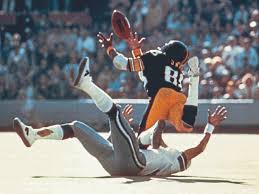
Lynn Swann defied conventional paths to NFL stardom. Ballet lessons, not backyard football games, shaped the early years of this Pittsburgh Steelers legend who would eventually earn four Super Bowl rings. Despite beginning with pirouettes rather than pigskins, Swann developed extraordinary body control and spatial awareness that would later become his trademark on the football field. His gravity-defying catches and elegant sideline footwork showcased a unique athleticism that transformed the wide receiver position forever. Furthermore, his journey from dance studios to the Hall of Fame demonstrates how unconventional training can create unparalleled excellence. This is the story of how a ballet dancer became one of the most graceful and accomplished wide receivers in NFL history, ultimately redefining what was possible on a football field.
The Ballet Dancer Who Would Become a Football Icon
Born on March 7, 1952, in Alcoa, Tennessee, in the foothills of the Great Smoky Mountains, Lynn Swann's journey to football greatness began with an unexpected twist. His family relocated to San Mateo, California, when he was just two years old. Settling in neighboring Foster City, young Swann stood out not for his football prowess but for his seemingly boundless energy and unique interests.
Growing Up in Foster City: An Unlikely Beginning
As the youngest of three boys, Swann faced the challenge of being smaller than his peers. "I was always smaller and younger than the other kids," he recalled. "My game had to be a mental one. I had to outsmart and out-quick the other kids and take advantage of mistakes." This early adaptability would serve him well throughout his career.
Growing up in Foster City presented other challenges too. At Serra High School, Swann was one of just nine African Americans in a student body of 900. This cultural isolation taught him important life lessons early on. "I learned very young the games people play," he reflected in a 1979 Sports Illustrated interview 2. Some white classmates treated him differently off the athletic fields, while some Black friends criticized him for attending a predominantly white school.
Surprisingly, Swann initially showed more promise in track than football. At Serra High, he set a school record in the long jump and subsequently won the 1970 California state championship, impressively defeating future Olympic gold medalist Randy Williams.
The Mother Who Changed Everything
Mildred Swann, a dental hygienist by profession, became the architect of her son's unique athletic development. Noticing Lynn's extraordinary energy as a youngster, she made a decision that would alter football history—she enrolled him in dance classes.
"When I was in grammar school," Swann recalled, "I felt more comfortable on the dance floor than the football field." His dance journey began around age four and continued until his senior year in high school.
Additionally, when Swann received an academic scholarship to Serra High School, he initially refused to attend the all-boys Catholic institution. "My mother made me go," he admitted years later. "She made me go on the foundation that education and what she instilled in my life have brought me here today."
Ballet, Basketball, and Breaking Stereotypes
While his older brother Calvin nurtured his interest in sports, Swann's dance training set him apart from other athletes. He studied various forms of dance including:
- Ballet for balance and body control
- Modern dance for fluidity of movement
- Tap dancing for rhythm and timing
This unconventional training regimen wasn't without social consequences. "You try leaving football practice with a pair of tights named Lynn at an all-boys Catholic high school. You'll find yourself learning a few moves," Swann joked during his Hall of Fame induction speech.
Nevertheless, Swann continued to excel athletically at Serra High School. Besides his track achievements, he played basketball and starred as a wide receiver for two seasons before becoming the team's quarterback in his senior year.
Interestingly, Swann's dance background actually provided unique advantages on the field. His tap teacher taught him that "the end of one move is the beginning of the next move. You had to be balanced in order to make that transition. There's a timing and rhythm to every play." This perspective gave him an edge that would later earn him the nickname "Baryshnikov of football" after his MVP performance in Super Bowl X.
Throughout his journey, Swann's early dance training instilled in him a distinctive style and approach to football. "My dance training has allowed me to develop a style that is pretty much my own style," he reflected near the end of his career, "something that's different from most of the other players."
From High School Star to USC Trojan
While still a student at Serra High School, Lynn Swann's athletic prowess extended far beyond the football field. His remarkable abilities would soon capture the attention of college recruiters across the nation, setting the stage for his legendary career at the University of Southern California.
Dominating the Long Jump: A State Championship
At the 1970 CIF California State championship meet, Swann showcased extraordinary talent by leaping an impressive 24 feet 10 inches to claim the state title in the long jump. What makes this achievement particularly noteworthy is that he defeated Randy Williams by just one-quarter of an inch—the same Randy Williams who would go on to win an Olympic gold medal in the long jump at the 1972 Olympics.
This victory wasn't an isolated achievement. Throughout his high school career at Serra, Swann demonstrated remarkable versatility as an athlete. He ran the 100-yard dash in 9.8 seconds and earned honor student status alongside his athletic accomplishments. His academic and athletic excellence earned him high school All-America honors, attracting recruiters from numerous colleges and universities.
Although Swann originally hoped to attend UCLA, fate had other plans. When UCLA didn't offer him a scholarship, he turned to their cross-town rival, USC. This decision would prove pivotal not only for Swann but for the future of USC football.
Becoming a Consensus All-American at USC
Once at USC, Swann rapidly established himself as an exceptional talent under the guidance of head coach John McKay. McKay recognized Swann's unique abilities early on, noting, "He has speed, soft hands, and grace"—qualities clearly influenced by his dance background.
Swann's collegiate career statistics tell the story of his consistent improvement:
- In 1971: 27 receptions for 305 yards and 2 touchdowns
- In 1972: 27 catches for 543 yards and 3 touchdowns, plus 117 yards rushing
- In 1973: 42 receptions for 714 yards and 6 touchdowns, along with 99 yards rushing
By the time his USC career concluded, Swann had set a then-school record of 96 receptions. He finished second in receiving yardage with 1,562 yards and became the third leading punt returner in school history. His extraordinary performances in 1973 earned him unanimous first-team All-America honors along with the prestigious Pop Warner Award, recognizing him as the best senior player on the Pacific Coast.
The 1972 National Championship Season
The pinnacle of Swann's collegiate career came during the 1972 season when he helped lead USC to an undefeated record and a national championship. That extraordinary team dominated college football, culminating in a Rose Bowl appearance.
Throughout that perfect season, Swann displayed the versatility that would later become his professional trademark. Although primarily known for his receiving abilities, his contributions extended to blocking as well. Indeed, in 1972, he was named to the All-America Blockers Team selected by the Chattanooga Times—an unusual distinction for a wide receiver.
According to Swann himself, it wasn't until after this championship junior season that he seriously began considering a professional football career. The team's success and his individual contributions had confirmed what many already suspected—Lynn Swann possessed the skills to excel at the highest levels of the sport.
His USC career concluded with two Rose Bowl appearances and unanimous All-American recognition. More importantly, his time as a Trojan had transformed him from a multi-talented high school athlete into a polished receiver ready for professional football. The ballet dancer from Foster City had become a football star in Los Angeles, yet his greatest performances still lay ahead.
Pittsburgh's First Round Pick: The 1974 Draft Class
On January 29, 1974, the Pittsburgh Steelers made a decision that would alter NFL history forever. With the 21st overall pick in the first round, they selected USC wide receiver Lynn Swann. This choice marked the beginning of what many football historians consider the single greatest draft class any team has ever assembled.
Joining the Steel Curtain Dynasty
The Steelers had only recently become competitive after decades of futility. Prior to Chuck Noll's arrival as head coach, the franchise originated in 1933 and didn't make the playoffs until 1947. Under Noll's leadership, they had returned to the postseason in 1972 with the miraculous "Immaculate Reception" game, followed by another playoff appearance in 1973.
Swann arrived at precisely the right moment to help transform a promising team into a dynasty. The organization already featured quarterback Terry Bradshaw and running back Franco Harris, yet needed more offensive firepower. As Steelers scouts assembled their draft strategy, they debated between Swann and Alabama A&M receiver John Stallworth for their first pick.
Ultimately, the team chose Swann first because of his higher profile at USC, correctly believing Stallworth might remain available in later rounds. This strategic decision proved brilliant, as both receivers would eventually earn gold jackets in Canton.
Rookie Year: Leading the NFL in Punt Returns
Though Swann started just two games during his rookie season, catching only 11 passes for two touchdowns, his impact was immediate in another crucial area. He showcased his exceptional athleticism by leading the NFL in punt returns with 577 yards on 41 returns, a club record at the time and the fourth best in NFL history.
This remarkable special teams performance earned Swann a spot on the PFWA All-Rookie Team and foreshadowed the greatness that would follow.
The Greatest Draft Class in NFL History
What makes the Steelers' 1974 draft truly extraordinary is that Swann was merely the first of four future Hall of Famers selected:
- Lynn Swann (1st round, 21st overall) - Future Super Bowl X MVP
- Jack Lambert (2nd round, 46th overall) - Future NFL Defensive Rookie of the Year
- John Stallworth (4th round, 82nd overall) - Future All-Pro receiver
- Mike Webster (5th round, 125th overall) - Future five-time All-Pro center
Incredibly, the Steelers added a fifth Hall of Famer when they signed undrafted free agent safety Donnie Shell. No team before or since has matched this extraordinary achievement.
Together with previous draft picks like Joe Greene and Franco Harris, these rookies formed the foundation of a team that would win four Super Bowls over the next six seasons.
Four Super Bowl Rings and a Legacy of Grace
The highlight of Lynn Swann's NFL career came on the biggest stage in professional football. Suffering a concussion in the 1975 AFC Championship Game against the Oakland Raiders, many doubted he would even play in Super Bowl X. Yet not only did Swann play, he delivered a performance that would forever change how wide receivers were perceived.
Super Bowl X: The Performance That Changed Everything
Swann's recovery from his concussion set the stage for arguably the greatest Super Bowl performance by any wide receiver. Against the Dallas Cowboys, he caught four passes for a then-Super Bowl record 161 yards. His 64-yard touchdown reception late in the game put Pittsburgh ahead 21-10, sealing their 21-17 victory. As a result, Swann became the first wide receiver to earn Super Bowl MVP honors.
The Acrobatic Catches That Defined an Era
Three of Swann's four catches in Super Bowl X were, as one veteran reporter noted, "of the 'break-out-the-thesaurus variety'". His most iconic reception—a 53-yard circus grab where he dived, tipped the ball, performed a midair twist, and caught it while lying on the ground—ranks fifth on NFL Films' list of "Greatest Catches of All Time". Certainly, this play epitomized his extraordinary body control.
How Dance Training Made Him Unstoppable
Football analysts often describe Swann's movements as "poetry in motion". His ballet background provided exceptional balance, body control, and jumping ability. Moreover, Swann openly credited his dance training as vital to his football success, opening doors for future players to incorporate dance into their training regimens .
336 Receptions and 51 Touchdowns: The Final Numbers
Throughout nine seasons with the Steelers, Swann amassed impressive statistics: 336 receptions for 5,462 yards and 51 touchdowns 2. His Super Bowl performances were particularly remarkable—he set five Super Bowl records including career receptions, career receiving yards, and career touchdown receptions 2. Ultimately, the "Ballet Master of the NFL" 13 helped Pittsburgh secure four championships in six seasons (1974-1979) 15, cementing his legacy as one of football's most graceful playmakers.
Life After the Steelers: Broadcasting, Politics, and USC
Transitioning seamlessly from football to broadcasting, Lynn Swann's post-NFL career proved equally impressive. After hanging up his cleats, he built a multifaceted career spanning media, politics, public service, and university administration.
Three Decades with ABC Sports
Swann's broadcasting journey began in 1976 while still playing for Pittsburgh. Following his 1983 retirement, he joined ABC Sports full-time, where he remained until 2006. His versatile on-air presence included hosting and analyzing events ranging from Olympics to horse racing. Swann covered the Winter and Summer Olympics from 1976 to 1988, Monday Night Football, the Kentucky Derby, and various international sporting events.
The 2006 Pennsylvania Governor Race
In 2006, Swann entered politics as the Republican candidate for Pennsylvania governor. Though polls initially showed him in a statistical tie with incumbent Ed Rendell, Swann ultimately received 40% of votes compared to Rendell's 60%. His campaign earned considerable praise for its organization and focus as he attempted to become Pennsylvania's first African-American governor.
Chairman of the President's Council on Physical Fitness
President George W. Bush appointed Swann as Chairman of the President's Council on Physical Fitness and Sports in 2002. During his tenure (2002-2005), he launched presidentschallenge.org, which attracted 300,000 registered users within a year. Swann and Bush also established May as "National Physical Fitness and Sports" month.
Returning to USC as Athletic Director
Completing his career circle, Swann returned to USC as Athletic Director in 2016. Throughout his three-year tenure, USC secured five national championships across different sports. Under his leadership, student-athletes achieved an all-time high cumulative GPA and an 86% graduation rate. Ultimately, Swann resigned in September 2019 amid various administrative changes at the university.
Lynn Swann's remarkable journey from ballet studios to NFL greatness stands as one of sports' most extraordinary narratives. His career defied conventional wisdom about athletic development while forever changing how fans perceive the wide receiver position. Four Super Bowl rings, a Super Bowl MVP award, and 336 receptions later, Swann's legacy remains firmly cemented among football's greatest talents.
Throughout his nine seasons with Pittsburgh, Swann demonstrated how his dance background translated into unparalleled body control, timing, and spatial awareness. Those childhood ballet lessons, originally intended to channel his boundless energy, ultimately created the "Baryshnikov of football" whose acrobatic catches still appear in NFL highlight reels decades later.
Additionally, Swann's post-football accomplishments proved equally impressive. Three decades with ABC Sports, political aspirations, government service, and finally returning to USC as Athletic Director showcased his versatility beyond the gridiron.
Perhaps most significantly, Swann's success opened doors for athletes to embrace unconventional training methods. His willingness to credit ballet for his football achievements helped dismantle stereotypes about masculinity in sports while expanding how coaches view skill development.
The ballet dancer who became a football icon never compromised his uniqueness. Instead, Swann transformed perceived limitations into his greatest strengths. His graceful playing style captivated audiences while redefining athletic excellence. Undoubtedly, Lynn Swann's legacy endures not just through statistics or championships, but through the beautiful fusion of artistry and athletics that may never be replicated.

The Story of Mean Joe Greene